The Valentine That Broke and Mended My Heart
written by Liz Koch

It breaks my heart and then pieces it back together. That is the only way I can describe what it feels like to parent my disabled, neurodivergent children and to keep choosing this life with all its jagged edges.
The breaking is real. The mending is real too. I used to believe that if something hurt enough to shatter me, it meant I had done something wrong. Now I see that life has its own rhythm. It opens and closes, stretches and strains, and invites me to find steadiness inside the chaos.
Parenting my children has shown me a kind of love that fills me to the brim and still leaves room for ache. Their lives are full and meaningful, shaped by challenges they never chose. Their nervous systems move through the world raw and exposed, taking in more than they can always manage, and their responses are often misunderstood by people who only catch the surface.
Over time, I learned to model love through actions and to give encouragement that is practical instead of effusive.
I packed some of your safe foods.
I rescheduled the therapy appointment.
I refilled the medication early.
I checked the schedule so today will feel easier.
These small things have become my way of saying I am here and I love you.
Even with all the noise and overwhelm, I still offer declarations of love in gentle doses my children can receive. Tiny phrases tucked into car rides, whispered at bedtime, or offered when their bodies feel soft enough to hear them. Little I love yous shaped to their nervous systems, grounding them in the truth that they are cherished.
Some days the weight of everything presses hard. Therapy appointments crowd the calendar. IEP meetings stretch into long discussions about what might actually help. Meltdowns rise faster than I can predict, and by midday it feels as if I have lived a full lifetime.
Some moments land in my body like bruises. Big emotions in small bodies can leave marks, and the emotional impact lasts even longer. There have been nights when every muscle ached from holding my child through a storm of fear or overwhelm. There have been mornings when I felt tender in ways no one else could see.
Yet even then, life is not empty. It can bruise and nourish at the same time. It can drain me and still offer something beautiful. It can shake my faith in everything and still hand me moments that feel like tiny miracles. I call them durable moments of hope.
A smile that arrives in the middle of a hard morning, unforced and real.
A shared glance that says I’m trying when words just won’t come.
A soft “Can we go for a walk?” whispered at the edge of overwhelm, an invitation back into connection.
These small, quiet flashes rebuild me in ways I did not know I needed.
When I was younger, I lived through moments that hurt me, body and soul. I learned how to crawl back out even when the climb felt impossible. That history became a silent guide. It taught me that surviving and living are not the same, but one can lead to the other.
I built a life where hard things still happen, but they do not destroy me anymore. I learned to search for meaning in the wreckage and to find something small and redeeming even in moments that nearly undo me.
Somewhere in this process, I began to feel the invisible threads between us. Threads between me and my children. Threads between me and other parents who have carried both love and fear in the same breath. Threads between anyone whose heart has learned to break and mend in the same motion. We change each other simply by sharing space, by orbiting for a while in the same light. The connection hums with the feeling of being seen and seeing others in return.
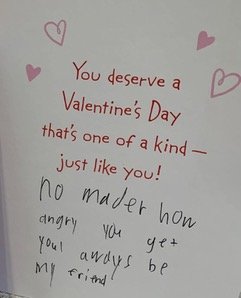
One of those hums came a few years ago when my son was in fourth grade. After his class Valentine’s Day party, we sat together and sorted through the cards. Most were the typical cartoon characters and quick greetings. Then I found one that made me stop.
Inside, a classmate had written, “no mader how angry you get youl aways be my friend.”
The spelling was imperfect. The sentiment was pure.
It broke my heart and then slowly put it back together again.
Being neurodivergent in a world designed for something else is exhausting. It wears on the body and the spirit. It wears even more heavily on children whose nervous systems are sensitive and easily overwhelmed, children who are trying to make sense of a world that moves too fast and expects too much.
As a parent, my deepest fear is that my children will not find places where they truly belong. Every parent knows this fear, but for families like ours, it feels wider and sharper. The world expects sameness. My children move with their own rhythm.
That little valentine shifted something inside me. It held a kind of hope I did not realize I was hungry for.
Hope that as I teach my child to accept himself, another child is learning to accept difference.
Hope that as I help my child recover from a meltdown or repair after a hard moment, another child is learning that friendship is larger than one difficult day.
Hope that the work we do at home is meeting the work educators are doing at school so that every child feels seen, safe, and welcomed.
Hope that a future exists where people of all neurotypes and abilities learn from one another with curiosity instead of judgment.
That valentine reminded me that life is not only a story of breaking. It is also a story of rebuilding. Sometimes the smallest gestures arrive right when the heaviness feels like too much. Sometimes a message from a child softens the weight and reminds me that hope is still growing quietly in the corners.
Every day, I feel those invisible threads between me and my children and between me and others who are walking their own complicated paths. Those threads remind me that we alter one another in ways that are small but real, simply by being here and by seeing one another.
And in that, something mends.
Liz Koch writes about the messy, meaningful realities of life and neurodiverse parenting. She shares the chaos, the triumphs, and the lessons learned, offering an honest look at the daily balancing act between family, identity, and growth.