written by Anika Atkins
If you've ever spent too many nights in a hospital room with your child, you learn to find focus in the strangest places. I’m lying here on a vinyl recliner that’s masquerading as a bed, neck craned, eyes locked on the ceiling light above me. It’s one of those big rectangular panels with the weird yellow glow—harsh and humming softly.
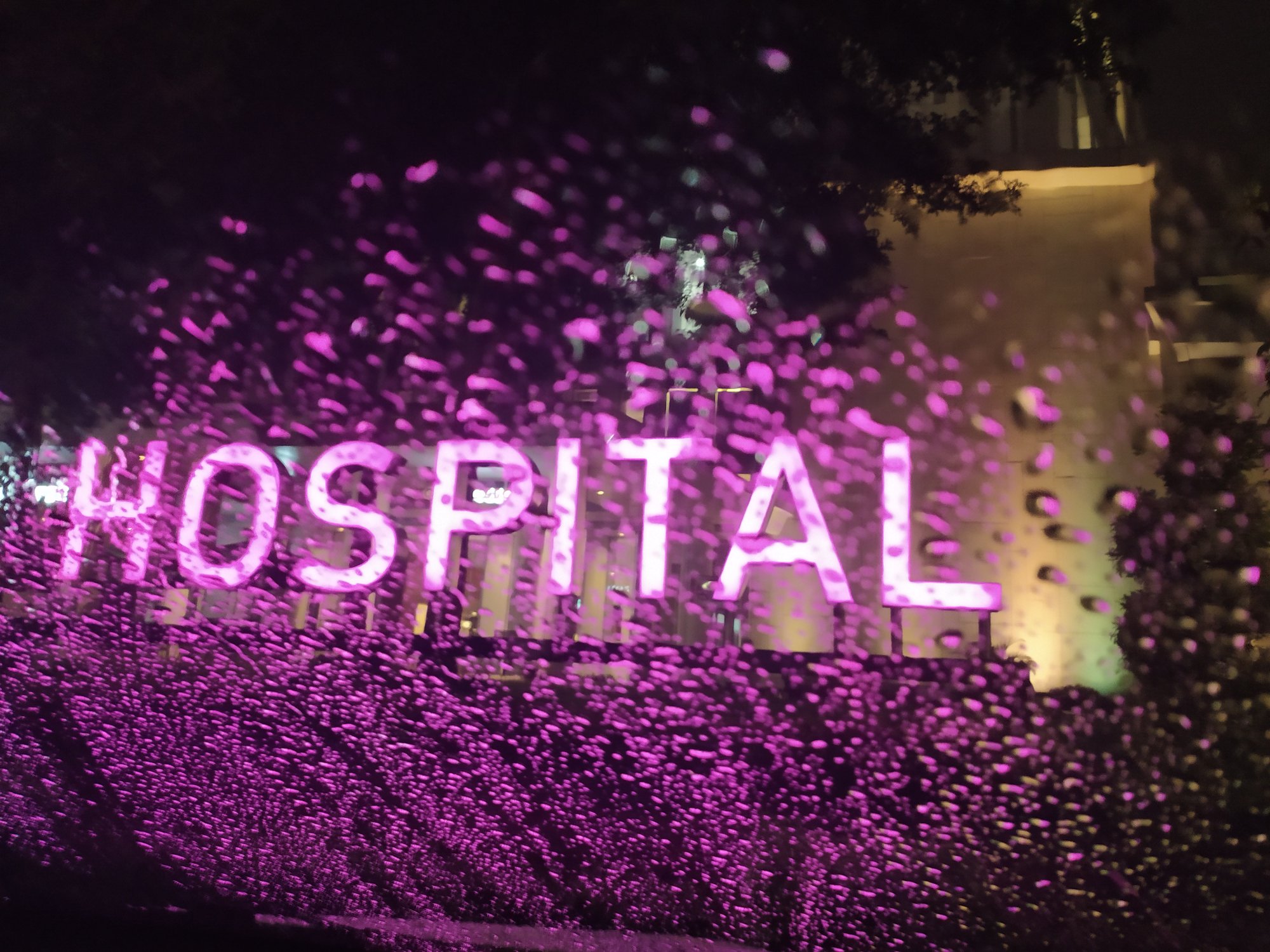
At 10:07 PM, that light has become my entire world. I stare at it like it’s a painting in a museum, because frankly, I’m too exhausted to look anywhere else. Parents like us know this routine: when worry and sleeplessness blur your vision, even a ridiculous ceiling light can turn into a focal point for your racing thoughts.
Tonight, that fluorescent beast on the ceiling is my neon moon. It’s oddly comforting in its consistency. I swear it’s the same model in every hospital we’ve ever been to. There’s a dead moth trapped inside the light cover (a tiny silhouette in the glow), and I catch myself wondering absurd things: Did it live its whole life in Pediatrics? Does it haunt these halls, warning other moths to stay away? Dark humor, I know. But when you’re on your umpteenth hospital stay, surreal humor becomes a lifeline. Better to chuckle at a doomed moth and a buzzing light than to drown in another wave of fear.
I shift my gaze to our 11-year-old daughter, Ella, curled up in the adjustable bed next to me. She’s awake too, propped up on pillows, her small figure dwarfed by rumpled hospital blankets. Ella is shy by nature, but here she grows oddly inquisitive and alert, as if the hospital is a classroom and tonight’s lesson is “Life 101”.
I see her studying the IV pump’s blinking lights and listening to the distant beeps down the hall. Even at this ungodly hour, her denim-colored eyes gleam with curiosity. She catches me looking and offers a tiny, brave smile. I smile back, trying to look reassuring rather than wrecked.
Inside, my heart aches with love and fierce protectiveness. She’s been through more in her 11 years than some people face in a lifetime, thanks to this rare disease that keeps throwing us curveballs. Yet here she is, managing a smile, analyzing the hospital tech like it’s an interesting science project. Her quiet courage humbles me.
At Ella’s other side sits my husband, her dad, my steady co-pilot on this turbulent flight. He’s perched on a stiff chair, one hand resting on Ella’s blanketed foot, the other playing a game on his iPhone. Even in the dim light, I can see he’s dressed in his usual calm uniform: a blue polo shirt and navy shorts, slightly rumpled from a long day.
He’s an airline pilot by trade, trained to stay cool when things get bumpy, and that’s exactly the energy he brings here. His face is relaxed, almost stoic, but I notice the subtle tension in his jaw. I know every micro-expression after all these years. This is his way of holding it together. He glances up and meets my eyes for a second, giving me a small nod. No words, just a steady look that says We’ve got this. In that moment, I’m grateful beyond measure for his calm. He’s my rock, keeping me from floating off into panic or despair. We’ve done this hospital drill so many times that we have a wordless language for it now.
Still gazing at that ceiling light, I feel my thoughts start to spiral—worry about tomorrow’s test results, anger that my child has to endure this, the familiar what-ifs prowling at the edges of my mind. I’m bracing myself against a tide of anxiety when, out of nowhere, my brain serves up an utterly random soundtrack. In the silence of the room, I hear it: the twangy guitar intro of “Neon Moon” by Brooks & Dunn, playing faintly in the back of my mind.
At first, I almost laugh out loud in surprise. Seriously, brain? Of all songs, that old 90s country ballad decides to make a cameo in my head. I haven’t heard it in ages, but here it is, uninvited yet oddly welcome. The chorus unwinds in my memory: “When the sun goes down on my side of town…” and I can practically hear Ronnie Dunn’s smooth voice crooning about lost love under a bar’s neon sign.
The absurdity is perfect. I mean, I’m literally lying beneath a neon-like hospital light, and I do feel a bit like I’m in a country song—minus the whiskey, plus an IV drip. In that song, a heartbroken guy spends “most every night beneath the light of a neon moon” pining for his lost love. And here I am, spending yet another night under a neon hospital moon, worried sick I might lose my love, my Ella. The parallel is not lost on me, and it’s so corny and cosmic that I can’t help but laugh a little.
It’s like the universe DJ-ed this just for us flawed souls in Room 412. My mind feels a since of nostalgia as the song plays on in my head. Oddly, a flash of college nights pops up. I feel comforted by this silly mental jukebox moment—like some part of me is reminding the rest of me that we’re not alone in this, that meaning can show up in the strangest places when you’ve been through enough.
Apparently, I’ve been staring at the ceiling with a goofy smirk, because Ella notices. “Mom?” she whispers, her voice slicing gently through the quiet. I blink and come back to reality. The fluorescent panel above fades to just a light fixture again and the song in my head softens. I turn to Ella and squeeze her hand, which is small and a bit clammy but strong in its own way.
“I’m here, my little B,” our fav nickname. Her eyebrows scrunch in that endearing mix of worry and curiosity. “What were you thinking about?” she asks shyly. How do I answer that? That my brain was line-dancing in a cowboy bar for a minute? I chuckle softly, brushing a stray hair off her forehead. “Oh, just… the light,” I say, winking. “It reminds me of an old song.” Ella knows my sense of humor by now; she gives me a tiny eyeroll coupled with a ghost of a smile, like she’s saying Mom’s being weird, but she’s okay.
From the other side of the bed, I hear a low rumble of quiet laughter. My husband is grinning now; his stoic pilot facade cracked just a bit. “Careful,” he says in his calm, dry tone, “I might ask you to dance to that song in here.” His eyes are twinkling as he teases me. I snort, actually snort, and Ella giggles at the thought of her parents dancing in a hospital room. We also both look like stiff statues when we dance. I stick my tongue out at him in mock offense, feeling a rush of affection. Just like that, the heaviness in the room lifts a little. We’re smiling.
In this stupid-hard place, in this absurd situation, we’ve found a bubble of normalcy—a family moment that could be happening around our kitchen table, not under hospital fluorescents. My husband reaches over and pats my leg gently, a silent acknowledgement for our lack of dance moves and a reassurance all in one. I take his hand for a moment and squeeze back. No words needed. We’re grounding each other again, keeping each other sane.
When the quiet settles in again, I find myself reflecting in that half-dazed, late-at-night way. How strange, how beautiful that a random country song in my head and a dead moth in a light fixture have teamed up to give me perspective. I realize that over these past couple of years of hospital trips, we’ve learned to take meaning wherever we can find it.
Sometimes it’s in the grim humor about cafeteria food or the bizarre art in the waiting room. Sometimes it’s deeper—like a lyric that suddenly rings true, or the way Ella asks a question that cuts to the heart of things. (“Will I now always need to use a wheelchair” she once asked with big, concerned eyes, and it shattered my heart and broke it in new places.) You start to understand that when you’ve been through enough, the universe’s random moments don’t feel so random. They feel like little winks, inside jokes between you and life, urging you onward.
I glance at Ella, who’s now absently picking at her cheek and at my husband, who has leaned back with eyes closed. He is just resting, not asleep. My eyes return to that ceiling light one more time, and it doesn’t seem as harsh now. In its off-white glow, I see the reflection of the three of us: mother, father, daughter—each of us worn out, each of us bringing our unique set of strengths.
It hits me that the strength in this room isn’t just flowing one way. It’s not parent-to-child only, or spouse-to-spouse in turns. It’s circular, a quiet energy that passes between us constantly. When I’m close to falling apart, I see my husband’s steady hands and I borrow his calm. When his eyes betray fatigue, I catch Ella laughing at his latest and frankly, bad dad joke and I watch his stress melt into laughter. She gives him that gift of laughter. And when Ella is scared, she looks at me and her dad and sees confidence and love even when we are faking the confidence part, and she draws bravery from us.
We hold each other up, three legs of a stool, balancing something precious on our backs. Each of us carries a part of the weight of this illness, so no one must shoulder it alone.
I realize we’ve become unshakable, not because any one of us is a superhero, but because together we form something solid. There’s a resilience in this tiny, sterilized room that’s bigger than any diagnosis. It’s in the way we still find reasons to laugh, however dark or small. It’s in the way we know each other’s breaking points and step in at just the right moment with a joke, a squeeze of the hand, or simply a silent presence.
We’ve been tempered by every blood test result, every long night of fevers, every hopeful whisper of “Maybe this time it’s good news” (which happens every once in a while).We’ve been broken and re-forged so many times that now our family bond is like the bamboo wet can’t get rid of in our backyard—flexible, yes, but so, so strong.
Ella yawns, and I know we should all try to get some rest before the next round of poking and prodding at dawn. I lean over and kiss her forehead. “Try to sleep, Ella B. We’ll be right here when you wake up.” She nods sleepily. My husband stands and gently adjusts her blanket, ever the careful father. Then he rubs my shoulder. “You too,” he murmurs—pilot’s orders.
I finally recline my chair-contraption and he sits back in his, our hands finding each other in the space between. Above us, the ceiling light shines on, as indifferent and constant as the moon. I close my eyes and, for a moment, hear the last strains of “Neon Moon” still echoing in my mind. I imagine we’re all beneath a friendly neon moon tonight—ridiculous as that sounds—and that its light is ours, guarding us. It’s shining on the three of us in our little cocoon of pillows and prayer, illuminating every ounce of love and humor and fight we’ve gathered.
This road is hard, no denying that. But lying here, hand in hand with my husband, Ella finally drifting off, I feel a profound truth settle in my bones: We are in this together, and together we are so much stronger than we ever imagined. It’s taken countless hospital visits, countless long nights under unforgiving lights, but we’ve learned how to make our own gentle glow in the darkness.
We’ve become a family bonded by resilience, humor, and fierce love, unshakable in the face of whatever comes next. And as I finally let myself relax under that ever-watchful ceiling light, I know that as long as we three share this strength—as long as there’s light from our own neon moon—we will find a way through the night, together.

Anika Atkins is a Rare Disease Advocate, Devoted Mother and Wife who, in a former life, taught medical ethics but who now lives it!